
ginger bee farm
Keeping a healthy flock
Poultry require the same level of care and attention as any other homestead animal, and in some areas, they require extra consideration. Feeding, housing, and birds’ mental and physical condition all contribute to a healthy bird who can lay nutritious eggs, bring diversity and utility to a property, and provide a good meal for the table. We pay attention to every part of that equation to give all our birds (and their offspring) productive, happy lives.
What’s Important?
Feed
Chickens, especially layers, need a high-quality diet with a good balance of minerals to support egg production. We choose to feed a nutritionally complete pellet with supplemental calcium always available. Our chickens get scratch grain, veggie scraps, and forage as an enriching treat.
Housing
All our coops are easily cleanable, draft-free, and use grates and roosts to ensure the chickens are always clean and dry in their houses. With good housing, chickens stay warm and cozy in even the worst weather. Coops are cleaned weekly, and nest boxes are padded with clean straw.
Health
Preventing disease with careful management is key to maintaining a long-lived, contented flock. Our health strategy involves active disease prevention, monitoring, and effective treatment if a problem arises. Our chickens are dewormed twice yearly, and a combination of litter management and natural coccidiostats mean our coccidial load is kept low.
NPIP and Biosecurity
Like any animal, chickens are at risk for getting and passing on various diseases and infections. Some of these diseases are a significant threat to the flock and to the caretakers who tend it, and they can escalate beyond the backyard if not monitored properly. We take steps to prevent these diseases and work with our state’s veterinary resources to ensure our chickens, family members, other livestock, and customers are safe and secure.
What is NPIP?
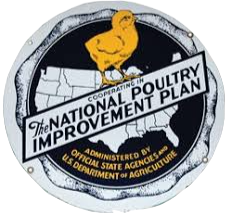
NPIP stands for the National Poultry Improvement Project. From NPIP’s website, “the National Poultry Improvement Plan was established in the early 1930s to provide a cooperative industry, state, and federal program through which new diagnostic technology can be effectively applied to the improvement of poultry and poultry products throughout the country.” One of NPIP’s key functions is disease testing to prevent the spread of common poultry diseases, chief among these being highly pathogenic Avian Influenza (HPAI), Fowl Typhoid, and Pullorum disease, though the project also has the capacity to test for various other diseases, including M. gallisepticum. Poultry producers who join NPIP have had their birds tested by a state official and, at a minimum, have received a negative test for Pullorum-Typhoid. These producers commit to certain biosecurity protocols as well as to sourcing future birds, chicks, or hatching eggs only from other NPIP producers. As part of our NPIP commitment, Ginger Bee Farm is dedicated to improving our flock through selective breeding, high standards of husbandry, and birds who are healthy and safe to handle and raise.
Our standards and certifications
Ginger Bee Poultry is a certified and inspected NPIP Independent Flock, tested clean for HPAI and Pullorum-Typhoid with the state of New Hampshire. Our NPIP number is #12-304. We are also enrolled in a current Mycoplasma gallisepticum (MG) testing program with the NH Department of Agriculture, with testing every three months, so we can give our customers an added level of assurance when it comes to the health of their chickens.
Biosecurity measures
A big part of NPIP is maintaining biosecurity measures around your poultry. Those measures are what keep us, our chickens, and their eggs safe and healthy. In our case, that means a dedicated set of equipment and clothing that is used for, and only for, chicken care. Boots that have set foot in the pig pens don’t step in the poultry pens, the chicken coveralls aren’t in contact with the goats, and so on. Visitors stay at least 150ft from the chicken pens at all times, and we have a dedicated area for chicken manure and soiled litter. All poultry pens are fully enclosed by wire or netting, meaning direct contact with wild birds and other animals is prevented. By restricting how far material from the chickens travels on the property, and by preventing soiled material from entering their runs, the chickens have a perimeter of safety that safeguards against pathogens going into or out of their zone.
Pest management
Anyone who owns livestock knows that pests are a reality, no matter how big or small your operation is. Our goal on-farm is to reduce pest numbers and, critically, to eliminate pest/livestock interactions. Rodents are kept in check passively by limiting food sources (treadle feeders, frequent cleaning, containing grain spills) and actively by introducing non-hazardous controls (barn cats, owl houses, and monitored snap traps).
Breeding matters
Many poultry breeders line-breed repeatedly to concentrate egg color. That absolutely works to increase egg pigmentation and texture, but it also increases and concentrates harmful mutations.
One or two generations of line breeding can be beneficial to a breeding program, but successive generations with higher coefficients of inbreeding will often show halted embryo development and higher proportions of chick death, defects (ex. crossbeak, missing and/or curled toes), and adult mortality in chicks that do survive.
By encouraging genetic diversity through bringing in new genetics and making breeding choices based on detailed pedigrees, poultry from Ginger Bee Farm get the best start possible. It also means getting to our goal of diverse, colorful eggs takes longer, but we think that’s a fair trade-off for producing chickens who will be an asset your backyard, homestead, or farm.
If you have any questions about our poultry program, please don’t hesitate to ask via email. We want everyone who purchases poultry from us to be confident in the farm they’ve chosen.