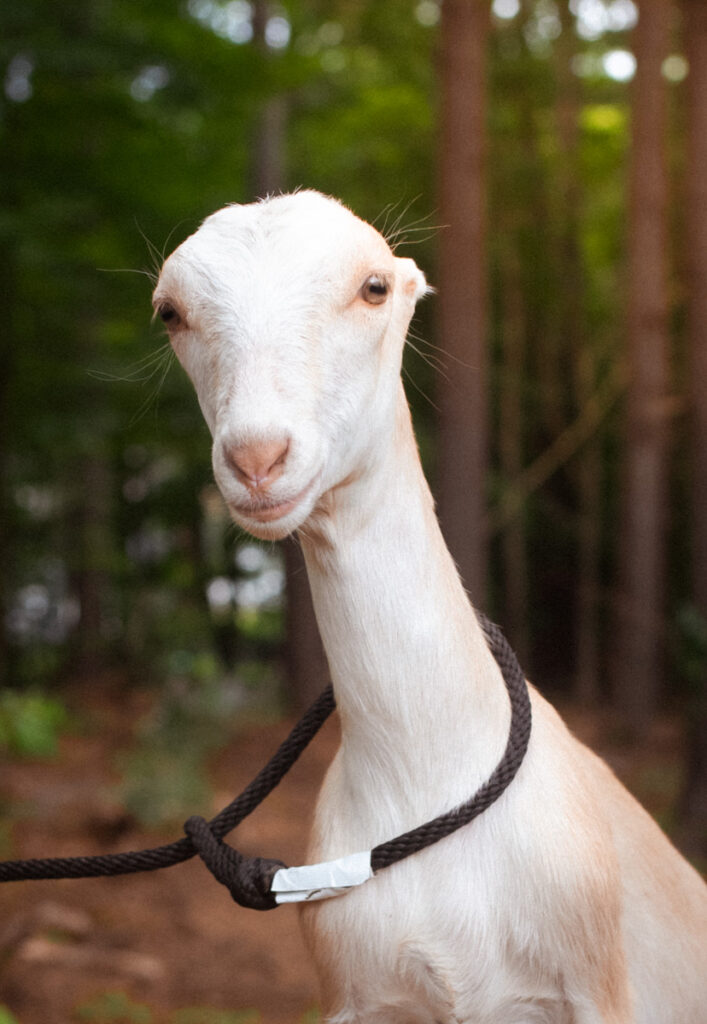
Dairy goats grazing on pasture at Ginger Bee Farm in Plaistow, NH
ginger bee farm

How we breed dairy goats

We are committed to the dairy goat in the role it has had for millennia — a powerful, useful, and productive farm partner. Our driving purpose is to fulfill these three goals:

At Ginger Bee Farm, our dairy goat program is built around four commitments: thoughtful breed stewardship, honest feeding practices, productive family-scale milking, and preserving the distinctive character of each breed. Use the links to jump straight to the section you care about.

milk production should be high - under good management

We select for heavy production and efficient use of feed – and we feed a lot. We do not believe that dairy goats are or should be low-input animals or “easy keepers”: we select them to take lots of good food and good attention and turn it into lots of great milk. We take great care of our animals, and we expect our buyers to do the same.

Breeds should maintain their distinctions and value

We do the majority of our breedings via time-travel (decades-old frozen semen), and rely on pre-Unified Scorecard animals as the breeding backbone of our herd. Our Saanens are large and produce heavily; our Lamanchas are compact and solid; our Nubians tend to the “British Anglo-Nubian” style, deerlike and deep-bodied.

three goats should feed a family

Dairy independence for a typical family should be possible with two to three goats in milk. That means all the milk, cheese, cream, butter, and everything else a family of four(ish) needs should be met by no more than three does, giving one to two gallons per milker per day in a long, steady, and predictable lactation of ten months. 

Young dairy goat kids leaping and playing together at Ginger Bee Farm

Three goats for dairy independence

production is important!


We think that there’s a temptation in goat breeding to focus so much on a pretty, stylish doe that we forget that this is an animal that should be feeding a family. There’s absolutely nothing wrong with having a fancy little doeling (we love them too!), but fancy is as fancy does. That baby better grow up and be giving a substantial amount of milk, or she’s not doing what she was born and developed to do.


If you come to us for a family milker, our goal is that three milkers will allow you to stop visiting the grocery store dairy aisle, if you are an average-size family. That means all the milk you want to drink, cream for your coffee, fresh and aged cheeses, yogurt, and so on. In our experience, that requires between three and six gallons a day, which will make three quarts to drink, eight ounces of cream for tea and coffee, and a weekly butter-and-cheese batch with the leftover skim and whey fed to the chickens and the pigs.

Healthy, productive dairy goats need more than good genetics. On our Dairy Goat Management page we share how we feed for family milk production, what a nourishing diet actually looks like, and why common goat-keeping advice can short-change a milking doe.

Soapbox: Our philosophy on dairy goat breeds

Sleepy dairy goat kid yawning in the barn at Ginger Bee Farm
A little background about why we’re so committed to our breeds and what makes them different: 


In 1989, the American Dairy Goat Association significantly modified its Scorecard, which is the set of descriptions judges and breeders use to evaluate goats against the hypothetical ideal. The Type Committee, in its infinite wisdom, implemented an approach that they literally referred to as “put a bag over the head of the goat.” Heads could differ, but all breed body types should be identical. In other words, rather than having the compact and thrifty Lamancha, the deer-like Nubian, the powerful Saanen, and so on, all dairy goats were to look exactly the same except for heads. This, combined with other Type Committee decisions (such as “bigger is better,” another direct quote) and a devaluing of body capacity (and the complete removal of udder capacity as a category), came together to describe a very large, very long goat with a tendency toward being a tube rather than a deep wedge. To breeders, it became clear that the ideal goat should have a small, very high, very compact and tight udder.


This approach succeeded incredibly well, so that within a very few generations all purebred goats (with the possible exception of the Nigerian Dwarf) had the same outline, height, udder shape, topline, etc. The bag-over-the-head vision had come to fruition; aside from color and ears, by the early 2000s there were very few (if any) substantive differences between breeds. In addition, in the show-bred population of dairy goats udders had become substantially smaller and milk production lower as the strong preference for ultra high, tight udders was expressed in breeding decisions. 


We are passionately opposed to this approach, and we believe that the Type Committee was both philosophically wrong and factually incorrect.


The justification given for blurring the differences between breeds was that “breed characteristics have no effect on longevity or productivity,” an assertion we now know is totally false. Both genetically and epigenetically, there are big differences between and unique strategies available to varying body types. For example, smaller frames (such as was found in the Lamancha before the scorecard change) generally mean better feed efficiency, and animals with better feed efficiency raise healthier kids, produce more milk per calorie, and are much more profitable.


On the other end of the body-shape spectrum, animals with larger frames but looser skin and narrower barrels (the pre-change Nubian) are more tolerant to heat stress and climate-change stress, and can adjust their feed intake more easily to cope with temperature changes.


Both of these differences lead directly and immediately to how long an animal will be productive in a herd (longevity) and how much the animal contributes to the farm economy (productivity).


And, of course, a cute, high, tight udder that holds two pints of milk maximum on a 150-lb standard-breed goat is pretty much useless, and we believe that dairy goats should be the opposite of useless.


So what are we doing about it? The answer is in the big nitrogen tank downstairs, where we keep the 70s, 80s, and 90s on ice. We are incredibly grateful to wise breeders who kept these “old dead guys” operative over the decades. With every breeding we travel back in time, which is a tremendously exciting (and always surprising!) process. If you’re excited about what we’re doing too, we’d love to help you find the right goats for your family.

Dairy goat journal, july 1989

OK, fine, you want to bring back the breed differentiation – what does that mean? What would I notice if I bought a goat from you?

Lamancha

We believe the Lamancha should be a compact goat with an amazing mammary system and outsized production for its size. They are shorter in leg and body than some of the other breeds, and are likely to carry a little more flesh than the others. We don't overvalue "dairy character" in our Lamanchas; they must be high producers, but we don't mind if they look sturdy and strong while they're doing it.

Nubian

The Nubian is, historically, a mix between several Indian and African dairy goat breeds, and it should not look like a European-origin dairy goat. Nubians should be deep-bodied and beautifully blended, with a distinctive frame, free deer-like movement, and thin skin and coat. If you can picture a Gyr dairy cow next to a Holstein dairy cow, you'll get a decent idea of how Nubians should differ from the Swiss breeds.

Saanen

A great Saanen is like a full-masted galleon - she is powerful, beautiful, wide and strong, with a frame that can carry big healthy kids and produce gallons of milk a day without stress. The Saanen is the biggest of the breeds, and a good Saanen doe should tower over an equally good Lamancha doe. It should be almost impossible to get a Saanen fat; the more you feed them the more milk they should make.

Experimental/Recorded Grade

Sometimes the perfect family milker is in between these extremes. We've found that using Nubians as one parent tends to work really well, elevating butterfat and improving adaptability. "Snubians" are a huge favorite here, and Lamancha/Nubian crosses are dual-purpose gems.

Discover more

Poultry health standards –

ginger bee farm Keeping a healthy flock Poultry require the same level of care and attention as any other homestead animal, and in some areas, they require extra consideration. Feeding, housing, and birds’ mental and physical condition all contribute to a healthy bird who can

Explore

Ginger Bee Farm

Ginger Bee farm: Renewing the land through wise and respectful use leaving everything better than we found it Coastal New England is a tough area to farm. We have a lot of dirt, but very little good soil, and the most reliable yearly crop is

Explore

Kune Kune Pigs

Kune Kune Pigs heritage pork raised with patience and respect Coastal New England is a tough area to farm. We have a lot of dirt, but very little good soil, and the most reliable yearly crop is rocks. Our wild swings in precipitation, our temperature

Explore